Saturday, March 11, 2017
Markie Z Letter - "The Vibe" @markandrewz: Public Action and Political Action or Nothing
Markie Z Letter - "The Vibe" @markandrewz: Public Action and Political Action or Nothing: This morning "The Vibe" felt the choices people have at hand. Some contemplate accepting things as they exist and some acce...

Public Action and Political Action or Nothing

This morning "The Vibe" felt the choices people have at hand. Some contemplate accepting things as they exist and some accept the responsibility to change things. Many ask for the wisdom to know the difference. They may be the wisest of all.
Many undertake public action which is the choice that pertains to the capacity in which one comes into contact with the community. Others undertake political action which is designed to attain a purpose by the use of political power or by activity in political channels.
"The Vibe" is obviously getting strong signals from activity in political channels from across the globe. Healthcare, immigration, wiretapping, deals with foreign countries and their agents, business or political. That is not to mention, slurs, name calling and all sorts of demeaning going around. We have non-answers to questions and alternative facts. Selective memory and skillful neglect. These are interesting terms to say the least. But, there are a gazillion more in the shadows of the grey area within the emerald forest filled with smoke and mirrors.
We chose to vote. "The Vibe" felt a vibe and voted. Every single person got that one right because there is no wrong. It is our inalienable right provided we are eighteen years old. That also means we carry a responsibility for those that are younger, whether they are our family members or not.
We chose representatives. These are the people that decided to take public action and undertake political action to attain a purpose on their and our behalf. Oftentimes, it is a political party agenda. one pulls the "straight line" ticket. It is usually based on one tenet, issue or principal. I will bet that many people vote in that manner.
Making decisions in that manner are not wrong. They are based on a lot of faith. Faith in our representatives at every level of governance. Yes, it does affect our prices for food, gas, transportation, healthcare, lifestyle, safety, first responder emergency assistance. "The Vibe" has to give a major shout out to the first responders, the military, the intelligence services, the educators and all the good people in our country. Most of us always want to help. It could be a tornado in Oklahoma, a wildfire in California, a blizzard in the mid-west, a hurricane upon our shores, or any other unforeseen calamity.
Dear Representatives:
We will help you help us. It is truly not the other way around. But remember, we have faith in you. All we ask for is good candid communication, truth, honesty, integrity and that you remember us.
"The Vibe:" There is a lot of faith going on from a lot of people. It doesn't matter what political side(s) your on. Remember us...
Markie Z
@markandrewz
Mark Andrew Zwartynski
03.11.2017
'44 Uprising Productions
Thursday, February 16, 2017
Picking Up "The Vibe" - Markie Z Guest Blogger - Neil Wilson: Are The Days Of The Olympics Numbered?
Markie Z "The Vibe" Guest Blogger
NEIL WILSON: Are the days of the Olympics numbered?
THE NEIL WILSON COLUMN / An exclusive, authoritative series from Sports Features Communications
(SFC) There can be few families who have invested more of their lives in Olympic sport than the German brothers Robert and Christoph Harting.
Robert, the elder by six years, throws a discus so well that he was Olympic, world and European champion at the same time. He competed at three successive Olympic Games, winning his gold in 2012.
His brother ensured that the Olympic title remained in the family four years later in Rio when he won gold.
So it might have come as something of a surprise that young Christoph predicted this month that the Olympic will "slowly die" by 2040 unless his compatriot Thomas Bach resigns as president of the International Olympic Committee.
Except, like gold medals, that opinion runs in the family. Last year Robert was even more dismissive of Bach when he refused to ban Russia from the Rio Olympics because of its systemic doping. Bach, he said, "is part of the doping system, not the anti-doping system."
Christoph's latest prediction of slow death for the Games coincided with yet another European city deciding by referendum that it wanted nothing to do with hosting a Games. Sixty per cent in the Swiss canton of Graubuenden, which contains the cities of Davos and St Moritz, were opposed to a bid for the 2026 Winter Games, up several points from a similar vote taken four years ago on a bid for 2022.
They follow the citizens and administrations of Hamburg, Krakow, Munich, Oslo, Stockholm and Rome in pulling their bids, either after a public referendum or obvious public apathy. Just two cities remained for the 2022 vote, just three now for 2024. Now Europe is cold-shouldering another winter Games.
So Christoph Harting may be right in his assessment of the future but not necessarily in his understanding of the reason. Public perception of widespread doping in Olympic sport is probably the least of the reasons for the present negativity surrounding hosting a Games.
After all, nobody in Switzerland is any less excited these days when a Swiss stands on the podium when Olympic medals are awarded. Doping seems not to have turned off the public. The more likely motivation for its rejection is a collective failure of its citizenry to see any good reason for hosting an Olympic Games.
There have been pressing reasons in the past. Regeneration of an area is one that applied to Barcelona and London. Re-establishment in the global community was another. Think Tokyo and Seoul. Politics was another for Moscow and Beijing. The publicity value was often a reason for Winter Games bids.
St Moritz and Davos are rich communities. They could afford an Olympic Games. But why would they want one? They do not need regeneration. They are well endowed with hotels and sports facilities. They do not need publicity to attract tourists. They are world renowned. Try getting a hotel room there in the winter season. A Winter Olympics would interfere with the existing tourist market.
One Swiss regions remains interested in bidding for 2026 - Sion. It bid for the 2006 Games and lost to Turin. Its citizens have been offered a referendum next year on a second bid and expects a deep well of enthusiasm.
The five rings remain of value to multi-national companies for branding but for the citizens of the world less so. Bach's resignation would not solve that problem but it is time he came up with some answers. Or young Harting may be proved right.
** NEIL WILSON reported his first Olympic Games in Munich in 1972. He has since covered another nine summer and nine winter Olympics for various newspapers, including The Independent and the Daily Mail with whom he has worked for the last 19 years as Athletics and Olympic correspondent. He was Britain's Sports Journalist of the Year in 1984 and is the author of seven books.
Tuesday, January 31, 2017
Saturday, November 26, 2016
Music Industry & the 2016 Presidential Election
First in a Series
It is the Saturday after Thanksgiving 2016. Families have now come together to discuss the results of the 2016 Unites States of America Presidential Election. Although their may be some "Houses Divided," the United States has a Republican President Elect and a majority in both houses of Congress. Nonetheless, we have a Congress and Country divided. Businessman President-Elect Donald Trump won the majority of electoral votes 290 to Former First Lady, Senator and Secretary of State Hillary Clinton who garnered 232. Secretary Clinton won the popular vote over Businessman Donald Trump 64.4 million to 62.3 million. 2.1 million people more voted for Clinton over Trump.
Many music artists supported Secretary Clinton over Donald Trump. General wisdom speaks of artists wishing more work needs to be done for homeless, hungry, peace, climate, wage inequality, freedom of speech and many social justice issues relative to race, gender, policing, trade, government spending to name just a few. Many argue that all Americans essentially want the same actions taken.
It is just a matter of how to get there and how to get it done.
The music industry is going through its own discovery. A journey that changes minute by minute with the advent of new technologies and the deliverability of content to the market consumer. Spotify appears to be the leader in delivering musical content to the consumer for free or for a monthly subscription. The company is outpacing its competition with data collection used to provide what the consumer wants.
The big winner today in digital advertising is the advent of interactive delivery of content to the consumer as opposed to the consumer searching for what they want. At least, consumers now have both options to their avail. Data allows Spotify to make suggestions to the consumer via information gathered over time (short and long) and also interacting by allowing the consumer to give it a thumbs up or thumbs down. Same feature is provided by Netflix and others. Some people are now migrating away from conventional cable and satellite content deliverability to Netflix and You Tube as their entertainment providers.
Now that the Thanksgiving 2016 dinner conversation has concluded and people are ruminating over their own set of feelings and the reality of the state of the nation, music is still listened and film is still viewed. The winners? The winners are the artists who touch the individuals heart and soul through their work. The individual wins as well. Technology delivers the art. Business sets up the rules, payment and deliverability. How will the new administration, which controls the executive branch, the legislative branch and will have one Supreme Court Justice to appoint immediately, govern the business of of music and art?
Please feel free to provide your comments. They are graciously appreciated. Below, please find an article published in Billboard Magazine prior to the election.
All the best until next time,
Markie Z (@markandrewz)
http://markandrewz.blogspot.com/


Trump, on the other hand, has had a good deal less musical co-signs, the most prominent coming from Kid Rock, Wayne Newton, as well as usual suspects Rich, Nugent, Boone and Kenny Rogers. Kiss' loud and proud bassist/singer Gene Simmons was labeled the "Donald Trump of rock" recently by his son, Nick Simmons.
Las Vegas icon Newton went on Fox News earlier this month and said that if America has "ever needed Donald Trump, it's now." Kid Rock, an avowed Republican, hasn't stumped for the billionaire real estate mogul (though he told Rolling Stone in February that he was "digging" the candidate), but when Clinton made a crack about Rock possibly getting a cabinet position in a Donald White House, the Detroit rapper joked, "I don't care what your politics are, funny is funny!"


Tuesday, September 13, 2016
World's Mind Made Up on US Presidential Race
Markie Z Letter - @markandrewz Guest Blogger: Brian Stokes
World's Mind Made Up on US Presidential Race
Pew Research Center survey in 15 nations: Obama is tough act to follow, Clinton is more trusted than Trump
YaleGlobal, 16 August 2016
 |
| World watch on America: US President Barack Obama is highly popular in Europe, top; Donald Trump’s isolationist policies attract global anxiety |
WASHINGTON: When on November 8 Americans head to the polls to elect the next president of the United States, they effectively select the de facto president of the world. And, history suggests, whoever becomes the next resident of the White House – Democrat Hillary Clinton or Republican Donald Trump – he or she will impact America’s image, and thus US influence, around the world.
Of the two principal presidential candidates, Clinton is the better known outside the United States. Having served as US secretary of state from 2009 to early 2013, Clinton enjoys the confidence of many in both Europe and Asia to do the right thing in world affairs, according to a recent survey of 15 nations by the Pew Research Center.
Majorities or pluralities in 12 of 14 European and Asian countries have faith in Clinton, including the Swedes, 83 percent; Germans, 79 percent; Australians, 70 percent; Japanese, 70 percent; and Canadians, 60 percent. On the other hand, views of Clinton among the Chinese are much more divided, with 37 percent saying they have confidence in her, 35 percent saying they do not have confidence and 28 percent with no opinion. And Clinton is still little known in India, where a majority, 56 percent, voices no opinion about her ability to act on world affairs.
Views of real estate magnate Trump are a different story. Less than a quarter of people across all 15 countries surveyed in 2016 express confidence in Donald Trump’s ability to do the right thing regarding international affairs. In fact, overwhelming majorities in most of the societies surveyed have little or no confidence in him. This includes 92 percent of Swedes, 89 percent of Germans, 88 percent of Dutch and 85 percent of both the French and British.
Most Australians at 87 percent as well as Japanese, 82 percent, and Canadians, 80 percent, also lack faith in Trump. People in Asia’s two most populated nations have little knowledge of the Republican candidate. In China, there is a split between those who have no confidence in Trump, 40 percent, and those who do not offer an opinion, 39 percent. In India, 67 percent offer no opinion.
The next president, Clinton or Trump, faces the challenge
of comparisons with Obama. |
The candidate who heads to the White House in January, whether Trump or Clinton, faces the daunting challenge of comparison with Barack Obama, who is leaving office enjoying widespread public confidence in his conduct of foreign affairs. In Europe, majorities in nine of 10 countries surveyed this year trust the outgoing president’s ability to handle international issues, including 93 percent in Sweden and 91 percent in the Netherlands. Only the Greeks regard Obama unfavorably, with 58 percent expressing little or no confidence in him.
Obama has fewer fans in Asia, but is still popular: 78 percent in Japan, 58 percent in India and 52 percent in China voice faith in Obama’s record on the world stage.
History suggests that foreign confidence in US presidential leadership can be a consequence of the triumph of hope over experience. In 2008 in Europe, in the wake of the Iraq war and other issues that put Washington at loggerheads with other countries, trust in then-President George W. Bush had fallen to 16 percent in the United Kingdom, 14 percent in Germany and 13 percent in France, according to a Pew Research Center survey. In 2009, soon after Obama had been elected, but before he had been tested by events, 93 percent of the Germans expressed confidence in the new US president, and 91 percent of the French and 86 percent of the British agreed.
Americans’ choice can influence foreign judgment of the United States, and in countries surveyed, majorities or pluralities said Obama’s election led them to have a more favorable view of the United States. Again, Western Europe and especially France, 93 percent more favorable, and Germany, 91 percent, stood out in this regard, but also 77 percent of Japanese and Brazilians, 73 percent of Indonesians and 47 percent of Chinese expressed the view that the election had buoyed their view of the United States.
| Confidence in US Leaders Regarding World Affairs |
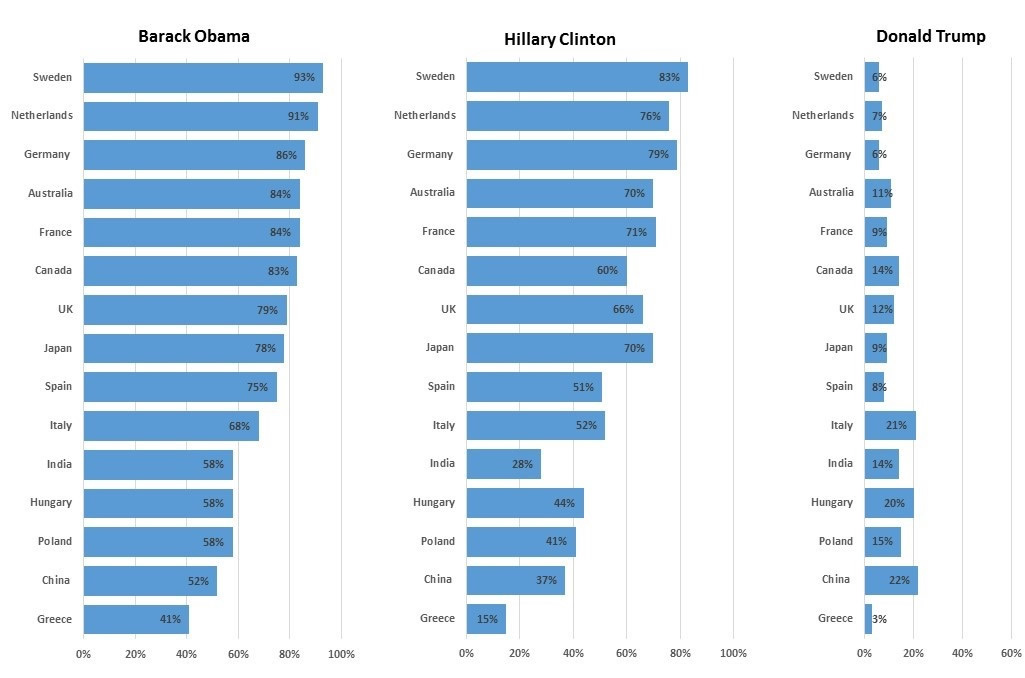 |
| Tough act to follow: A Pew Research Center survey conducted in 15 nations suggests that confidence runs high in US President Barack Obama "to do the right thing regarding world affairs"; Hillary Clinton, former US secretary of State, follows close behind, while doubt lingers about real estate developer Donald Trump (Data: Pew Research Center). |
The outcome of the 2004 American election had the opposite effect. A 2005 Pew Research Centersurvey found that after the reelection of George W. Bush in not one of 15 countries surveyed did a majority or plurality report that Bush’s reelection led them to holding a more favorable view of the United States. In Germany, France and Canada, roughly three in four respondents said the election’s outcome caused them to have a less positive opinion of Uncle Sam. This may reflect waning support for the Iraq war among those nations that had joined the US invasion and growing opposition to the US-led war on terrorism.
On the eve of the 2016 election, majorities in 13 out of 15 countries surveyed by the Pew Research Center have positive views of the United States. America receives its highest ratings from the Poles, 74 percent; Italians, 72 percent; Japanese, 72 percent; and Swedes, 69 percent. The survey shows that the US also enjoys support from Indians at 56 percent and Chinese at 50 percent.
Whether international views of the US change in the wake of the upcoming election may depend on whom voters choose and foreigners’ expectations of that incoming president.
In 2009, in 15 of 24 countries surveyed by the Pew Research Center, not including the United States, majorities or pluralities assumed that Obama would not act unilaterally and would consider the interests of countries like theirs when making foreign policy decisions. In 16 of the nations surveyed, public opinion leaned toward the view that Obama would be fair in dealing with the Israelis and the Palestinians. And in 19 nations, majorities or pluralities expected the United States under Obama to take significant measures to control global climate change.
But by 2012, in 14 of the same countries surveyed again, a median of 58 percent said Obama had acted unilaterally, 60 percent said he was not fair in dealing with the Israeli-Palestinian situation and 62 percent suggested that he had failed to take significant steps on climate change.
Foreigners look on the US electoral process with a mixture of hope and anxiety.
|
This reversal in sentiment is a reminder that foreigners can have unrealistic expectations of American presidents. And their disappointment when their expectations are not realized may affect views of both the presidency and the country. Between early 2009, during Obama’s honeymoon period, and 2012, international approval of Obama’s international policies fell significantly in Europe, Muslim countries, Russia, China, Japan and Mexico. In the same period, favorable views of the US declined in Germany, Britain, France, Jordan, Egypt, Lebanon and Mexico.
Without a vote in the US presidential election, foreigners look on the American electoral process with a mixture of hopefulness and anxiety. The process to date has not proved encouraging. Three-quarters of Australians and nearly seven in ten Canadians, among the foreigners who arguably may follow the US election the most closely, have a negative impression of the 2016 US presidential campaign. They know that Americans’ decision will affect their lives in ways they cannot control. They know Trump less well than Clinton and have greater confidence in her than in him. So non-Americans hope for the best, and history suggests they can be disappointed. Both their expectations and likely disappointments will affect the next US president’s ability to lead the world.
Bruce Stokes is director of global economic attitudes at the Pew Research Center.
Rights:Copyright © 2016 YaleGlobal and the MacMillan Cente
Subscribe to:
Posts (Atom)